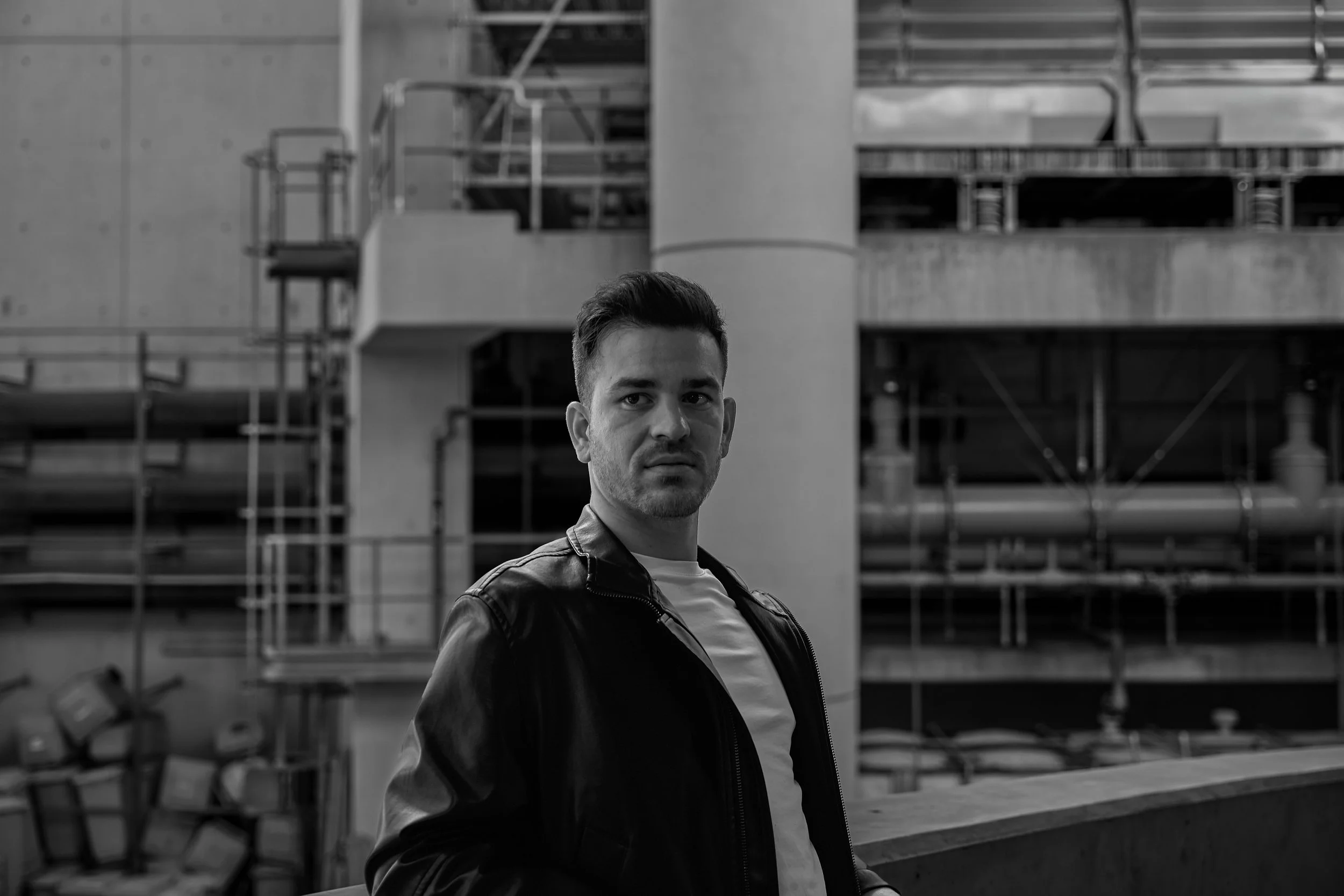
Greek artist SERA J has made waves across Europe and beyond with his precision productions, sets and future ready sound which still pays homage to the past. Deeply inspired by the Detroit techno legacy, SERA J’s sound is a dynamic fusion of driving basslines, high-energy grooves, and intricate, captivating details. With standout releases on renowned labels such as Mutual Rytm, Life in Patterns, and Projekts. His latest release is the track, "Triangles" on the ANNĒ curated v/a on Nastia's TECHNO Records. To mark the occasion, we interview the artist about his past, his productions, modern dance floors and more.
The Brvtalist: For anyone unfamiliar with the project, tell us about the formation of Sera J - your musical background and how you developed your sound.
SERA J: I’m a techno artist, producer, and DJ born and based in Thessaloniki, Greece. From a very young age I was listening to electronic music. I actually started with tech house and deep house, and later I discovered techno through a USB stick my brother had given me. That moment really marked the beginning of my journey into the genre, with early influences like Jeff Mills and Robert Hood, and a strong connection to Detroit techno and ‘90s–2000s house and Techno music.
I began playing music as a DJ in my hometown, Thessaloniki, and later moved into music production, because I wanted not only to play music, but to create and perform my own tracks. From that point on, I started searching deeply for sounds, artists, and different techniques that could help me shape a personal identity. I attended many parties and listened to a huge amount of music to gather inspiration that would later translate into ideas and studio experimentation. Day by day, with a lot of work, patience, and continuous self-development, I managed to start collaborating with record labels and releasing my own music with a distinct character and signature sound, something I’m still evolving to this day.
Over the last two years, I’ve been able to fully translate what I build in the studio into the club environment through my live set. Today, I find myself with several releases on respected labels and the opportunity to consistently present my music live, which for me is the most rewarding part of the journey.
TB: Tell us about your track "Triangles" for this compilation and why you wanted to be a part of it.
SJ: "Triangles" was created with a strong focus on rhythm and movement. I wanted the track to feel hypnotic but physical at the same time, built around repeating patterns that slowly evolve and lock into a groove. From a technical point of view, it’s quite stripped back, a tight rhythmic framework, subtle modulation, and small shifts in texture that keep the energy moving without overcrowding the space.
I felt a genuine connection with the vision behind the release and the artists involved, and "Triangle"s fit naturally into that context. It wasn’t about forcing a track into a compilation, but about contributing something that feels honest and coherent within the overall idea.
TB: When you're asked to submit a track for something like this, is your approach different from what it might be for a solo release?
SJ: Yes, the approach is definitely different. For a compilation, I think more about context! How the track will exist alongside other artists and how it contributes to a larger story. I’m still staying true to my sound, but I’m more aware of balance, flow, and how the energy translates within a shared framework.
For a solo release, the focus is much more inward. It’s about building something deeper and allowing the tracks to unfold together over time, without compromise. With compilations, I aim for precision and clarity , for one strong idea, executed with intention while solo releases give me the space to explore multiple directions and layers of expression.
TB: With so many releases coming out each week, how do you think anything can stand out nowadays?
SJ: I think standing out today has less to do with volume and more to do with intention. With so much music being released, what really stays with people is honesty and consistency over time. You can feel when a track is made with patience and care, rather than urgency. For me, it’s about trusting a personal rhythm , releasing when something feels ready and meaningful, not just because the schedule demands it.
Music that stands out usually comes from artists who know who they are, take their time, and allow their sound to develop naturally. In the long run, depth and authenticity always travel further than noise.
TB: While it's never gone away, I think there's been a re-focus on more traditional, "Detroit style" techno in the last year or so. Why do you think that is?
SJ: I think that re-focus comes from a need for substance. Detroit techno has always been about groove, soul, and futurism and it carries emotion and purpose beyond just function. In times when the scene becomes very fast and saturated, people naturally gravitate back to sounds that feel timeless and rooted. That approach offers space and an identity. It’s music that works on the dancefloor but also holds meaning when you listen closely. I don’t see it as a trend returning, but as a reminder of core values in techno which will always resurface when artists and listeners are searching for something more lasting.
TB: Have you noticed any changes on the dance floor in terms of what type of music resonates with people?
SJ: The dance floor is always evolving. For me it’s about listening carefully and reading the room, then letting the track guide the energy rather than forcing it. People still want to move, but they also appreciate moments of space and calmness, a rhythm that pulls them in, not just a peak that pushes them forward. There’s an openness to sounds that feels layered, hypnotic, and immersive, where small shifts in rhythm or atmosphere can create a big emotional impact. And I do really think that crowd seeks for emotions!
It’s a more attentive and engaged kind of dancing, which I find really exciting.
TB: What's coming up next for you or anything else you want to mention.
SJ: What’s coming up next is quite exciting. The final chapter of Symbiosis III is on the way via Mutual Rytm, which is a split EP with ANNĒ and something I’m really proud of, as it closes a very meaningful trilogy for us. Alongside that, we’ve been doing some strong back-to-back sets together, and there are more B2Bs planned that I’m really looking forward to.
This year there’s also a lot of new music coming out, several powerful releases on great labels such as Hardgroove, Renegade Methodz, in addition to Mutual Rytm, and a number of very exciting shows lined up. Overall, it’s a year focused on growth, collaborations, and pushing my sound even further both in the studio and on stage!
So definitely keep an eye out. 😉
Follow SERA J and pick up the release here: https://linktr.ee/TECHNO.records